
Table of Contents
Let’s face it—Google algorithm updates can feel like a mysterious beast that’s always lurking, ready to strike when you least expect it. One day, your website is basking in the glory of top search rankings, and the next… it vanishes into the Google abyss.
If you’ve been in digital marketing or SEO for even a minute, you’ve probably asked yourself:
“What just happened to my traffic?” or “Why did Google hate that blog post I worked so hard on?”
Well, breathe easy. You’re in good company—and exactly where you need to be. Today, we’re going to demystify Google algorithm updates, understand why they happen, how they impact your site, and what you can do to stay on Google’s good side.
So, What Exactly Is a Google Algorithm Update?
Alright, let’s break it down.
Google algorithm is like the recipe it uses to decide which websites show up (and in what order) when someone searches for something. Think of it as Google’s way of matchmaking: it’s trying to pair the searcher with the best possible result.
Google Algorithm update is when Google tweaks that recipe.
Sometimes, it’s a tiny change—like adding a pinch more salt. Other times, it’s a complete overhaul—like throwing out the cake and baking a pie instead. These updates can influence where your website appears on Google’s search results page (aka the holy land of traffic).
Why Does Google Keep Updating the Algorithm?
Great question. And no, it’s not to ruin your week (although it might feel that way sometimes).
Google makes these updates to:
- Deliver better, more accurate search results
- Combat spam and shady SEO tricks
- Keep up with how people search (hello, voice search and mobile users)
- Encourage high-quality content creation
- Keep the web a better, safer place for users
Basically, it wants to ensure that when someone types in “best tacos near me,” they’re not getting a 2008 blog post written by a guy who’s never even tasted a taco.
Major Google Algorithm Updates (And What They Did)
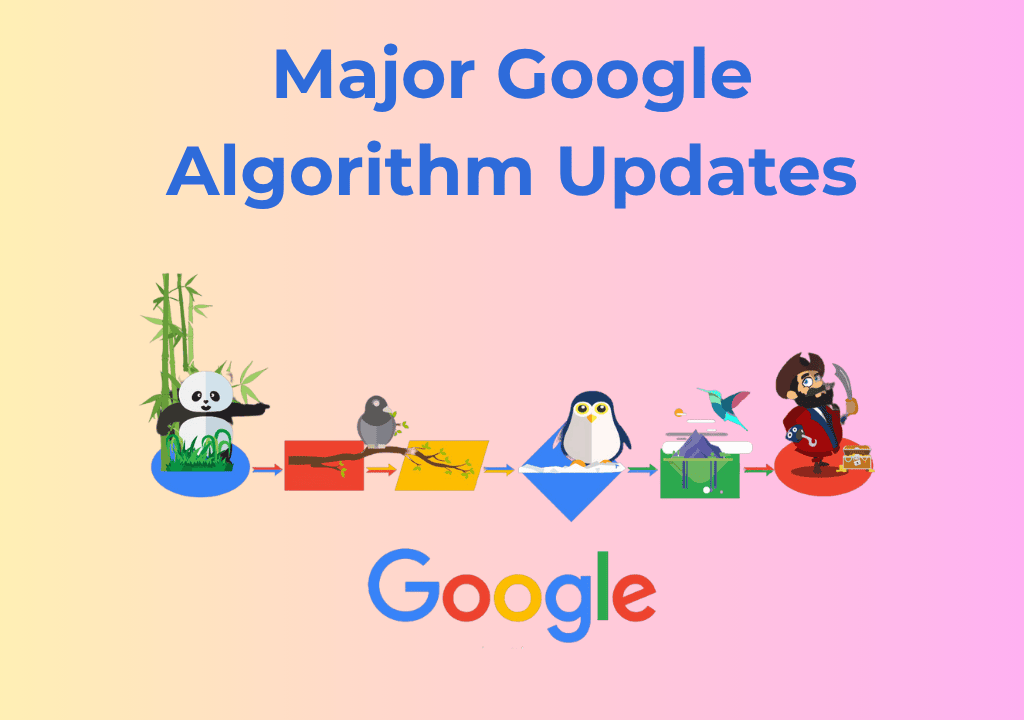
Now, let’s time travel a bit and explore the biggest, most game-changing Google Algorithm updates Google has rolled out. Some of these updates sent shockwaves through the SEO world—and if you weren’t prepared, you felt it.
1. Panda (2011)
Panda came in like a wrecking ball. It was Google’s way of saying, “Stop publishing garbage.”
Panda targeted:
- Thin content (shallow pages with little value)
- Duplicate content
- Content farms (sites pumping out low-quality articles just to rank)
The Fix: Focus on quality. Write content for humans, not search engines.
2. Penguin (2012)
If you were buying backlinks or engaging in shady link schemes, Penguin was your worst nightmare.
Penguin targeted:
- Spammy or irrelevant backlinks
- Over-optimized anchor text
The Fix: Build natural links. Prioritize value and relevance over link volume.
3. Hummingbird (2013)
Hummingbird was all about context. Instead of matching exact keywords, Google started trying to understand what users really meant.
It brought in:
- Semantic search
- Better understanding of conversational queries
The Fix: Think user intent. Don’t just stuff keywords—answer the real question behind the search.
4. Mobilegeddon (2015)
This one made it clear: if your site wasn’t mobile-friendly, you were going to lose visibility.
The Fix: Responsive design is a must. Mobile-first indexing is the future.
5. RankBrain (2015)
This was when Google got smarter. RankBrain uses machine learning to understand and sort search results more accurately.
It helped Google interpret:
- Ambiguous queries
- Never-seen-before searches
The Fix: Provide clear, well-structured, helpful content. Use natural language.
6. Medic Update (2018)
Called “Medic” because it hit health and wellness sites hard, this update emphasized E-A-T:
- Expertise
- Authoritativeness
- Trustworthiness
The Fix: Back your claims with credible sources. Build trust. Get cited. Be real.
7. BERT (2019)
BERT helped Google Algorithm better understand natural language. It’s basically the brain that helps it understand the full context of words in a sentence.
The Fix: Write like a human. Use natural phrasing. Don’t over-optimize.
8. Helpful Content Update (2022)
This one made it loud and clear: content should be people-first, not written solely for SEO.
The Fix: Avoid content that’s clearly written just to rank. Ask yourself, “Is this actually helpful to my audience?”
How to Know When an Update Hits
Sometimes, Google tells us. Most times, it doesn’t.
Here’s how you can sniff out an update:
- Sudden spike or drop in traffic or rankings
- SEO communities and forums blowing up (always a sign!)
- Google Search Central blog announces something official
- Tools like SEMrush Sensor, MozCast, or Rank Ranger show SERP volatility
Even when it’s silent, if something changes overnight, there’s a good chance to tweak the Google Algorithm .
What Happens to Your Website During an Update?
You might:
- Lose traffic
- Gain traffic
- Stay exactly the same
(Spoiler: the first two are way more common.)
Algorithm updates are like a reshuffling of the deck. If your content is useful, authoritative, and user-friendly, you might actually benefit. But if you’ve been skating by on keyword stuffing, clickbait, or poor UX—brace yourself.
Can You Recover from an Algorithm Hit?
Absolutely. But it takes some elbow grease.
Here’s how to bounce back:
- Audit your content
- Remove or improve low-quality pages.
- Ask: “Does this page serve a purpose?”
- Focus on E-A-T
- Add author bios.
- Cite credible sources.
- Build backlinks from trustworthy sites.
- Improve site performance
- Speed matters.
- Make it mobile-friendly.
- Ensure secure browsing (HTTPS).
- Fix technical SEO
- Crawl your site.
- Resolve broken links, redirects, and indexing issues.
- Get user feedback
- Use heatmaps, analytics, and direct surveys.
- Discover your audience’s needs—and deliver exactly what they’re looking for.
Common Myths About Algorithm Updates
Let’s bust a few myths while we’re at it:
❌ “Google is punishing my site.”
Not necessarily. You might not be penalized—you might just have been outperformed.
❌ “Adding more keywords will fix it.”
Please don’t. That’s so 2008. Write naturally.
❌ “SEO is dead.”
This one makes the rounds every year. It’s not dead. It’s evolving. And the people who adapt win.
How to Stay Ahead of Future Updates
You may not be able to see what’s coming, but you can definitely get ready for it.
- Create value-driven, helpful content
- Build authority in your niche
- Follow Google’s Quality Rater Guidelines
- Keep up with SEO news and trends
- Don’t chase quick wins—build long-term trust
In short: Play the long game. The internet is full of noise. Be the signal.
Stay in the Loop: Where to Follow Updates
Want to stay informed (without refreshing Twitter 20 times a day)?
Here are some legit resources:
- Google Search Central Blog
- Search Engine Journal
- Search Engine Land
- Twitter: @searchliaison (Google’s official liaison account)
- Tools: SEMrush, Moz, Ahrefs, Rank Ranger
Bookmark them. Follow them. Let them be your early warning system.
Final Thoughts: You’ve Got This
Algorithm updates might feel intimidating, but here’s the truth:
👉 If you’re creating content with the user in mind…
👉 If you’re building trust and authority in your space…
👉 If you’re staying curious and keeping up with changes…
You’re already ahead of the game.
Google isn’t the enemy. It just wants to serve the best content—and that’s your opportunity. Treat updates not as threats, but as nudges in the right direction. Ultimately, SEO isn’t about trying to outsmart the algorithm. It’s about earning your place.
If you found this helpful, consider sharing it with your team—or better yet, dive deeper by checking out our SEO Certification Program. Learn how to stay on top of updates and future-proof your digital strategy.
Because Google will change. The question is—will you be ready?
